

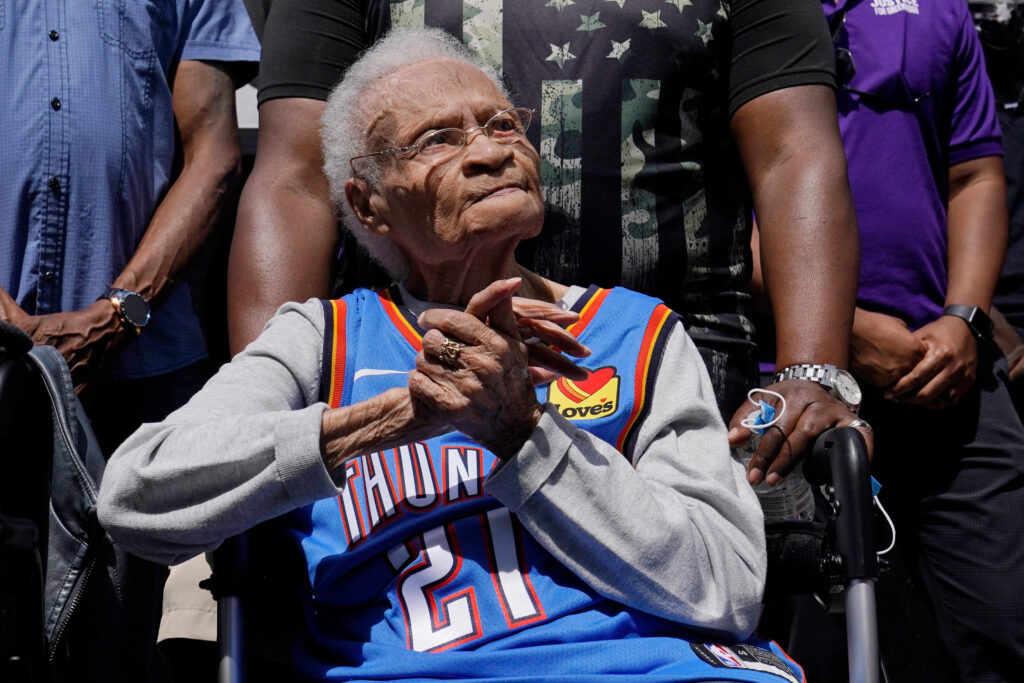
When Tulsa Race Massacre survivor Viola Ford Fletcher told her grandson that owning a home would bring her joy, she was 111 and had spent more than a century without the generational wealth stolen from her family in 1921.
The home never came for Fletcher, who was the oldest living survivor of the tragedy that destroyed a prosperous Black neighborhood and killed up to 300 people. Fletcher died Nov. 24 at a Tulsa hospital, just months after a grassroots GoFundMe campaign launched to fulfill what organizers called her “final wish”: a deed in her name, something to pass down, a tangible reversal of what the Tulsa Race Massacre had taken.
Now, more than $50,000 raised by more than 1,500 donors will instead go toward her celebrations of life and her legacy, organizers announced on social media following her death.
“Now that she has passed, the fundraiser will help support the preservation of her legacy through the Viola Ford Fletcher Foundation, and how they see fit with the family,” said Andrew Sartain, one of the fundraiser organizers. “Beyond that, we hope this moment keeps the conversation around reparations, generational theft, and historical justice alive. We can’t just honor elders when they’re gone. We need to act while they’re still here,” he said.
Supporters agreed.
“What struck me most is that a woman who survived one of the most horrific acts of racial violence in American history and spent more than a century demanding recognition of that pain still had to rely on community care for basic dignity,” said Lyric Christian, 28, a fan of Fletcher’s and the Manhattan-based founder of makeup brand Mind Candy Beauty.
“Mother Fletcher deserved generational security, not generational struggle,” Christian said. “Her story is a reminder that visibility for Black women has never equated to justice. We celebrate survivors, pioneers, and culture-shapers, but we rarely resource them in the ways they deserve. It’s heartbreaking proof that being seen does not always come with safety or stability. And yet, Black women continue to build, create, nurture, and lead anyway.”
The GoFundMe campaign, titled “A Home to Inherit,” launched on Aug. 13 with an ambitious $1 million goal. As of Dec. 3, that goal had been lowered to $60,000. Organizers, including Fletcher’s grandson Ike Howard, journalist Deon Osborne, and impact strategist Sartain, framed it explicitly as community care, not reparations. The distinction mattered: reparations, they noted, must come from those who perpetrated the harm.
The campaign also emerged in response to the city’s handling of the massacre’s legacy.
On June 1, 2025, Tulsa’s first Black mayor, Monroe Nichols, unveiled the “Road to Repair” plan, a $105 million private trust to address economic, educational, and health disparities in Greenwood and North Tulsa linked to the 1921 massacre.
But the plan offered no housing for the two remaining survivors — then Fletcher and Lessie Benningfield Randle — no direct payments, and no inheritance.
“While institutions can only move so fast with justice, we’re stepping in as a community to make sure it gets done,” the campaign organizers wrote.
Explained Sartain, “Many focus on the massacre itself, which is important, but overlook how the harm didn’t stop in 1921. Mother Fletcher lived 100-plus years of being denied basic opportunities. No reparations. No return of property. No recognition for most of her life. What happened after the massacre is the story, decades of silence and survival. That’s the weight she carried every day.”

Fletcher was 7 when white mobs destroyed Greenwood, the prosperous Black district known as Black Wall Street. In her 2021 congressional testimony, she described images that haunted her for 104 years: “I still see Black men being shot. I still smell smoke and see fire. I still see Black businesses being burned. I still hear airplanes flying overhead. I hear the screams.”
Her family fled with only the clothes they wore. They lost everything.
Fletcher \worked as a shipyard welder during World War II, then spent decades as a housekeeper, laboring until age 85. She raised three children. She survived domestic abuse. She built a life from ashes.
But she never owned property. At 111, despite testifying before Congress and being honored internationally, Fletcher shared living quarters with her fellow survivor, Benningfield Randle, with no deed and no inheritance to pass down.
Christian, whose brand Mind Candy Beauty centers Black women’s narratives via social media engagement, saw Fletcher’s story as emblematic of a broader pattern.
“Black women have always been the blueprint, yet too often we are denied the credits, resources, and platforms that our labor makes possible,” she said. “Just like Mother Fletcher, we often have to fight not just to exist, but to be believed, to be valued, and to be remembered.”
The campaign resonated across demographics. Donors saw in Fletcher’s story their own mothers and grandmothers — women who served as community pillars yet remained unprotected by systems that should honor them.
“Supporting her felt like a collective act of correction,” Christian said. “A way to say, ‘we see you, we value you, and we refuse to let history repeat its erasure.’”
Following Fletcher’s death, the campaign organizers posted an update: “While she didn’t get to cross that threshold, your support gave her hope, dignity, and the knowledge that she was not forgotten.”
The funds, managed by the Viola Ford Fletcher Foundation, will now support her memorial service and legacy preservation efforts. The Fletcher family and Greenwood community held celebrations of her life last Saturday, at the Center for Arts, Events and Community in Bartlesville, Oklahoma, and at the Greenwood Cultural Center in Tulsa.
“Mother Fletcher carried 111 years of truth, resilience, and grace and was a reminder of how far we’ve come and how far we must still go,” Mayor Nichols said. “She never stopped advocating for justice for the survivors and descendants of the 1921 Tulsa Race Massacre.”
For Christian, the symbolic weight of “a home to inherit” represents more than property ownership.
“It signifies ownership of our future,” she said. “The ability to pass down what was never given to us, including safety, opportunity, and the freedom to dream without starting from zero. Black women entrepreneurs are often building from ashes, from what was burned, overlooked, or taken.”
Howard, who helped launch the GoFundMe campaign, previously told The Associated Press that speaking publicly had been therapeutic for his grandmother.
“We don’t want history to repeat itself, so we do need to educate people about what happened and try to get people to understand why you need to be made whole, why you need to be repaired,” he said in 2024. “The generational wealth that was lost, the home, all the belongings, everything was lost in one night.”
While crowdfunding has become increasingly common for racial justice causes, from bail funds to funeral expenses for victims of police violence, campaigns seeking to secure housing or direct material repair for survivors of historical atrocities remain relatively rare, revealing a persistent gap between institutional recognition and tangible action.
Fletcher leaves behind children, grandchildren, great-grandchildren, and millions inspired by her fight for recognition.
“People from across the country have shown up, shared her story, and reminded us that even in a fractured political climate, justice for someone like Mother Fletcher resonates deeply,” Sartain said. “The community stepped up in a big way, and they’re still showing up, even now in her passing.”